What is the difference between Erasmian & Reconstructed Ancient Greek?

I gave a sketch here: Nick Nicholas’ answer to What are the pros and cons of the Erasmian pronunciation?

Erasmian is an early reconstruction of Ancient Greek. Compared to our current reconstruction, it’s not as distant from modern Western European languages, and it gets modified for ease of teaching in different countries.

Erasmian as taught tends to make the following concessions. (Happy to be corrected.)

  • Usually stress rather than pitch accent
  • Often fricatives rather than aspirated stops
  • Nativisation of diphthongs
  • Some distortions in the German version
  • Even more distortions in the French version

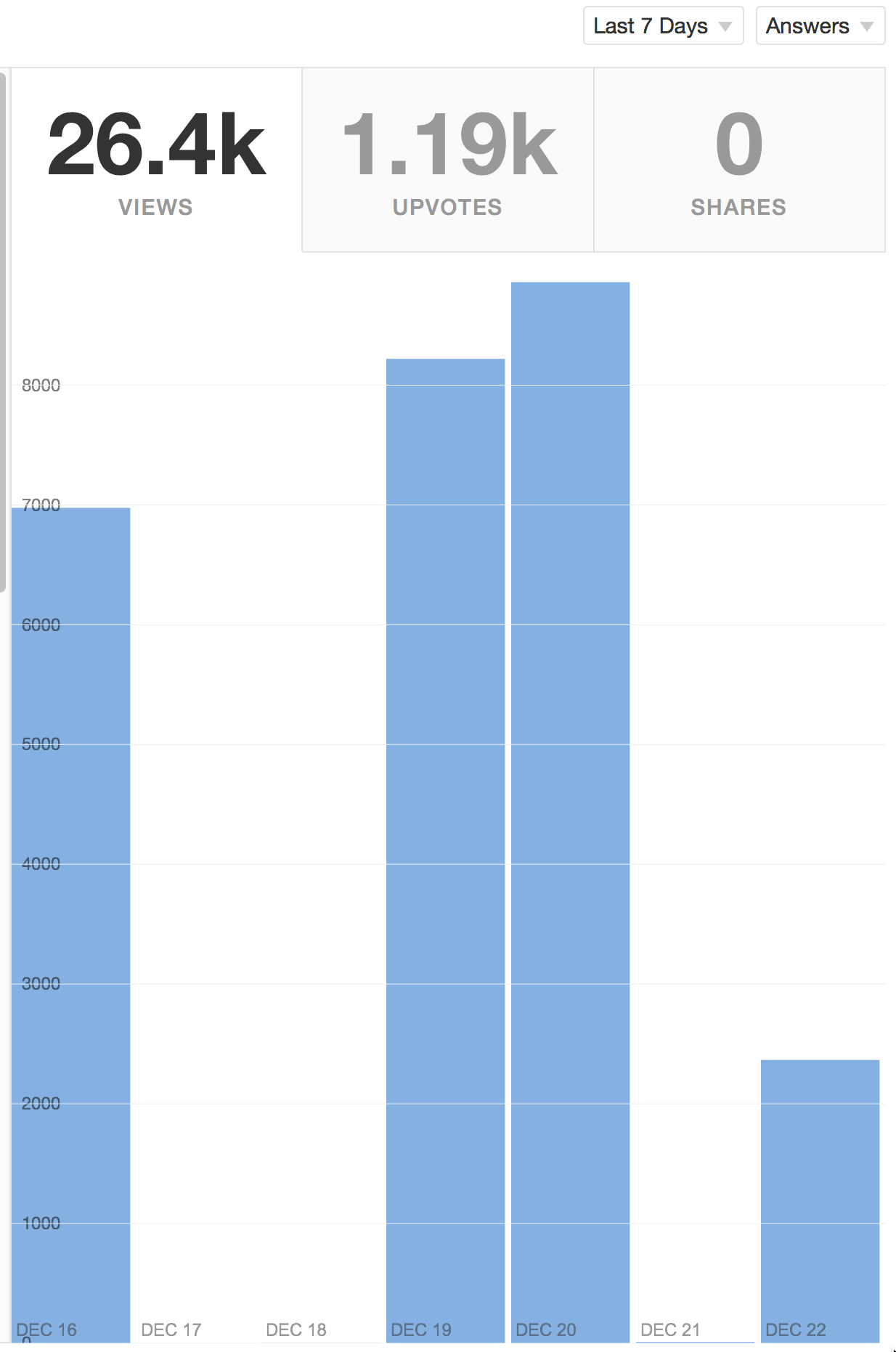
Where did Quora’s stats go for December 17th and 18th, 2016?

Assume bug. Happened to me too.

Presumably related bug: Views are decreasing! by Vishal Katyal on Rage against Quora. Views stats dropped on 18 Dec, reported on the 18th.

Where are my views? by Morgan Evans on Rage against Quora: disappeared on the day.

Who is Pegah Esmaili?

Pegah is an IT student, in her early twenties, living in a town in Iranian Azerbaijan. (She’s mentioned it here, and it wasn’t Tabriz, but I’m not doxing her. Besides, Quora Search.) She is a metalhead, she by her own admission finds it difficult to smile for photos, she has genocidal urges against men, and she is a… no, it would be inconceivable for her to be an unbeliever: she is a potato-chip worshipper.

(From one of her posts, saying that you can be a potato-chip worshipper, and the mullahs will leave you alone in Iran, so long as you don’t challenge their authority.)

I met Pegah via our mutual friend Lyonel Perabo, who has his own… fantastical account of Pegah as another response here.

Pegah is likely the best known Iranian on Quora. Certainly the best known to me. And Pegah plays a valuable role on Quora, of explaining Iranian and Azeri attitudes, Iranian daily life, Azeri and Iranian culture, to outsiders.

But to reduce Pegah to an Iranian, or an Azeri, or an explainer, is to insult her, and I will not. Not because she’ll threaten me, whatever our banter might indicate. But because I respect her. And because we’ve had wonderful exchanges here, trying to work out how similar our respective cultures are; swapping YouTube videos, quoting poems, and recognising the joy it gave us to share them with each other.

Pegah’s name means Dawn, but she’s not a daybreak; she’s a burning noon. She is passionate, and she is acerbic, and she is proud. It’s the pride that I admire most, all the more because it is tempered through her cynicism. She is proud to be Torki, and proud to be Irani, and proud to be a metalhead, and proud to be a potato-chip worshipper (or whatever that is code for).

And she would be a proud, burning noon wherever she was brought up. Being a member of a large minority in the Islamic Republic of Iran might give her cynicism an extra edge; but she’d be both proud and cynical (a potent combination) wherever she was brought up.

We had an exchange maybe last month, where I marvelled that we got along so well, when a century ago she would be my sworn enemy as a Greek; and Pegah protested. Surely we could have been common enemies against the Ottoman Empire.

No, Pegah, I know how religious communities within the Ottoman Empire worked. We massacred and banished our own fellow Greeks for being Muslims, after all, and they weren’t even Torki.

But thank you for suggesting we should have been allies. I would have been honoured to have someone as proud as Pegah as a sworn enemy then. And I’m honoured to count her among my friends now.

(You need to post more, though, Pegah. I miss your voice here.)

The Decalogue of Nick #1: I’m Greek-Australian

For Kaan Kılıçaslan.

I was born in Launceston, Tasmania, in 1971, to a father who had migrated from Cyprus and a mother who had migrated from Crete. We moved to Crete when I was 8. We moved back to Melbourne when I was 12. I’ve lived there since, but for 6 months in Greece in 1995, and living in Irvine, CA 1999–2001.

That makes me bi-cultural, I guess, which is a common thing in the diasporas of the world. It makes me somewhat atypical for the Greek diaspora in Australia, which trickled to a halt in 1975 (and restarted a couple of years ago). By living in Greece in the early 80s, and by retaining an intellectual interest in Greek culture, I’m more familiar with Greece than my generation of Greek–Australians.

Thank God for the Modern Greek collection of the University of Melbourne. And Thank God I got to it while that was still possible; it’s been in offsite storage for a decade now.

My history means that I’m neither fully Greek nor fully Australian. When I was doing Modern Greek in high school, Greek–Australian literature and commentary was awash with people of my generation up, bemoaning the fact that they were culturally adrift, and couldn’t call either side fully home.

That struck me as dramatic folderol. A few years later, when I had more perspective, and I understood it better. I will never grok cricket: if you don’t get it by 12, you won’t. I will never feel quite at home in Greece: they don’t act like I act. The clash between my parents’ fearful defensive upbringing of me and my liberal surroundings had landed me with a fair bit of baggage, some of it certainly sexual: any Australian TV soap I see, I reflexively wince at the bogan sex addicts.

But you know, feeling at some distance from your fellows is not a bad thing. I have baggage, and certainly didn’t get enough sex in my 20s, but I don’t feel debilitated by it. I think it helps me more analytical, more considered about how identity works. And being bi-cultural, I feel something of a responsibility to explain things on forums like this. To act like a bridge. It’s a useful thing, and I appreciate the other bridges I have encountered here.

My cultural grounding has been Greek, and Diaspora Greek at that. I got to see the very tail end of Greece as a third-world country in 1980, with donkeys in the village and minimal westernisation, with intact dialect and entrenched patriarchy and matriarchy divides. I’m grateful I saw it. I’m grateful to trace some of my emotional lineage to it.

Since the diaspora acts as a time capsule, my upbringing in Australia was not that far from the village I lived in in 1980. A lot about how Greece has changed since the 80s strikes me as odd. Dimitra Triantafyllidou has been a wonderfully patient instructor to me, in helping me catch up: yes, they have standup comedy in Greece now, who knew. But it’s one axis of distance.

The other is that a lot of my knowledge of Greek culture since has been book-learning. It’s been thorough, it’s been enthusiastic, but it has also been very intellectualised. My hyperdemotic slang owes more to the books of Nikos Tsiforos than to anything I heard on the street. I’ve savoured the best of Modern Greek literature; but I’m not comfortable telling a funny story in Greek.

(And I was proud as punch, during my honeymoon, when I was able to recount to my Greek relatives Nick Nicholas’ answer to Where did you meet your spouse? Booze helped.)

But my values were formed in Australia. I view the world as an Australian. My loyalty is to Australia, my national pride is Australian, and it is all the stronger because I haven’t had the fallback of Anzac and damper to fall back on as a mythology. I’m Greek, I know all about mythologies. I am an Australian citizen; I know what that truly means: Nick Nicholas’ answer to Do Australians like being Australian citizens?

When I came back from 6 months in Greece during my PhD in 1995, I announced to my parents that I could never live in a country where the civil service was that dysfunctional. My parents where agog: why would I give a shit about the civil service?! Greeks know how to live, man!

And yes, yes they do. But that’s not the life I have been formed to value. I value the life my fellow citizens value, here in Australia. I value order, and the rule of law, and the dependability of government services, and an uneventful civic life, and a healthy sarcasm towards the folly of the world.

Clarissa Lohr in PM, incidentally, wondered whether I failed to take to life in the US so completely, because my stock of identities was full already. Nah, it’s that I moved to the States at 28, formed no real friendships with locals, and I was stuck in fricking Irvine CA: Nick Nicholas’ answer to What is it like to live in Irvine, CA? But you know, two is plenty already to keep in your head.
The Decalogue of Nick

I’ve been contemplating writing about who I am here for a little while. Partly because it’s some overdue self-therapy, as I’m in an odd place now in life—at something of a turning point. Partly because I’m making new friends here, who don’t actually know that much about who I am.

The pretext for this came up at Nick Nicholas’ answer to Who is Nick Nicholas?, a question I will once again thank Pegah Esmaili for—even though I did go asking for it at Nick Nicholas’ answer to Who is Michael Koeberg?

There will be a post on here for each of the following:

  1. The Decalogue of Nick #1: I’m Greek-Australian.
  2. The Decalogue of Nick #2: I’ve trained as a linguist, and I have done computational linguistics stuff.
  3. The Decalogue of Nick #3: I work in schools IT policy.
  4. The Decalogue of Nick #4: Long history of engagement with artificial languages.
  5. The Decalogue of Nick #5: I’m a middle-aged cishet man, recently married, no kids.
  6. The Decalogue of Nick #6: Loud as a poor coverup for shyness, and with one’s usual share of psychological baggage.
  7. The Decalogue of Nick #7: I play the mandolin badly and the violin worse.
  8. The Decalogue of Nick #8: Politically centre-left blah.
  9. Culturally Christian but Atheist.
  10. I post too much here.

Among languages that presently use a non-Roman script, which are most likely to romanize in the coming decades?

As I groused at Brian Collins in his answer: it’s always political.

Scripts are bound to identity, and the major vehicle of identity in our age is the nation-state. So scripts that are tied up with the nation-state as emblematic—say, Greek or Thai—aren’t going away in a hurry.

Minority scripts in a country have been under clear threat, and will remain so. The scripts of India, though, are safe under federalism.

The obvious area where there will be movement are multi-nation scripts; they have been driven by ideology in the past, but that ideology might not be supported as strongly by the nation-state: they can come to be regarded as alien.

The only area I can see this playing out is where it has already been playing out: Cyrillic in the sphere of influence of the former Soviet Union. Cyrillic is already out in Moldova—and not coincidentally, is still mandatory in Transnistria. Cyrillic is obsolete, optional, or contentious in the independent -istans; but the Russian Federation is making sure it’s not going anywhere within Tatarstan.

Of course, the Roman script in the -istans isn’t the vehicle of Westernisation and modernisation: I think that imperative is no longer in play, though it clearly was a century ago. For the Turkic languages, the imperative is pan-Turkism.

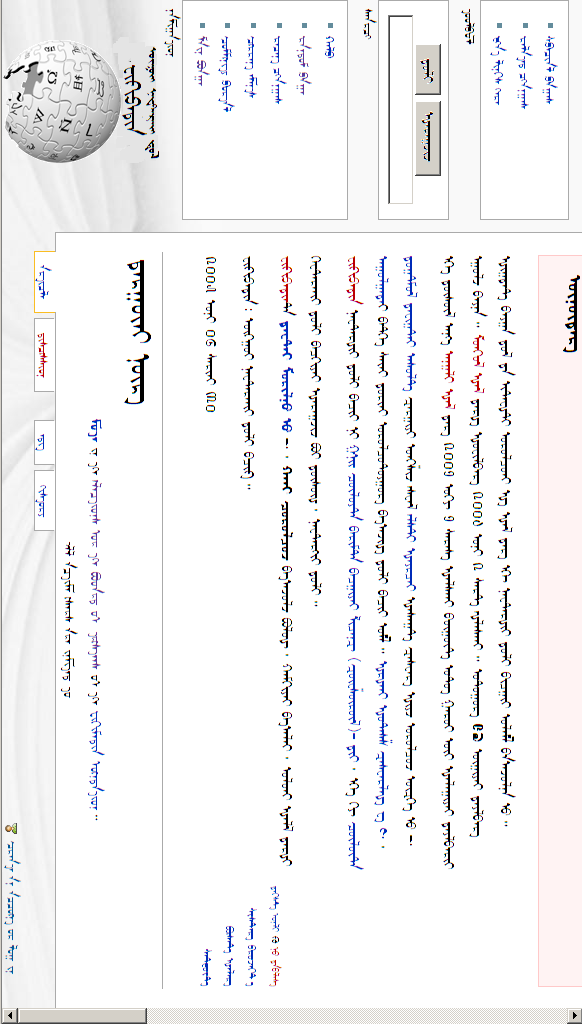
Mongolia is the other country to keep a watch on: Mongolian Cyrillic alphabet. I said to Brian that technology isn’t an issue, but Mongolian script does introduce vertical writing, which is awkward, and it hasn’t been in much use anywhere for close to a century. Not that well supported on the internets either: the following preview of the Mongolian script wikipedia is apparently faked.

So Mongolian script is handicapped. I would not be astonished if Mongolian Cyrillic goes away, but the -istans come first.

Do all men enjoy shemale porn?

I’m leaving out of my answer the role of mtf transgender performers in the transaction—on which see Do real transsexuals and “shemale porn” have nothing in common?, and the transactionality, on which see Is it wrong of me to enjoy “shemale” porn? I know it’s degrading and fetishizing, but what can I do about the fact that I like it?

Uncontroversially, I trust: some cis het men enjoy mtf transgender porn, and some cis het men are repulsed by it.

And that’s spelling out stuff your question didn’t, OP. I don’t know what the stats are on cis gay men enjoying mtf transgender porn. Or for that matter transgender people enjoying it. (Then again, I don’t have the stats on cis het men; I trust someone does, at Pornhub if nowhere else.)

That’s not really the interesting question, and I surmise not the question OP is actually getting at. The question is more, what kind of cis het men enjoy mtf transgender porn—and, more interesting still: what does that tell us about their construction of heterosexuality, and femininity?

Bear in mind that the performers in TS porn are a subset of transgender performances of sexual identity, which themselves are a subset of queer sexual identities.

  • TS porn involves women who have transitioned mtf, but almost never involves them having gender-affirming “bottom surgery” (I can think of only one performer, and she was already established).
  • TS porn involves women who for the most part embrace the social characteristics of femininity (long hair, breasts, makeup): they are not drag performers, who identify as men and satirise the construct, or genderfluid people, whose performance of sexual identity is deliberately ambiguous.
  • TS porn involves transwomen performing solo, with cismen or transwomen, much more than it involves them performing with ciswomen.

What kind of cis het men like TS porn?

Men who are still, at some level, het (or bi). They are attracted to performances of femininity. To be blunt, they are much more comfortable with someone who looks like a women performing fellatio or receiving anal sex, than they would be with a macho bearded man doing so.

There is a societal and a narrowly biological understanding of femininity from the cis het perspective. Viewers of TS porn may be confronted to realise that their construct is broader than just narrowly biological. (Those whose construct isn’t will be repulsed by TS porn, and won’t consume it further.) Of course, porn is always about kink, and that’s part of the kink. The kink clearly exists. (It explains where there are almost no “post-op” performers.) But the kink doesn’t do as much as you might think to undermine heterosexuality.

Hence complaints about TS porn adhering to a heteronormative construct of femininity or attractiveness. Hence why there are few performers who don’t look overtly feminine (though non-zero). Hence, if you think about it, why there are relatively few scenes involving mtf women and cis women.

Of course, mtf women are also shows as tops, both of transwomen and of cis men. It’d be interesting to see whether as many cis het men are OK with those depictions: they pose a bit more of a challenge to heteronormativity. But then again, so does pegging.


Elliott Mason brings up the question Does being attracted to transgender women who have penises, or porn involving them, mean a man is gay? This is a rich source of information, in some part because it has been overenthusastically merged.

Do you like Quora’s new “credentials”?

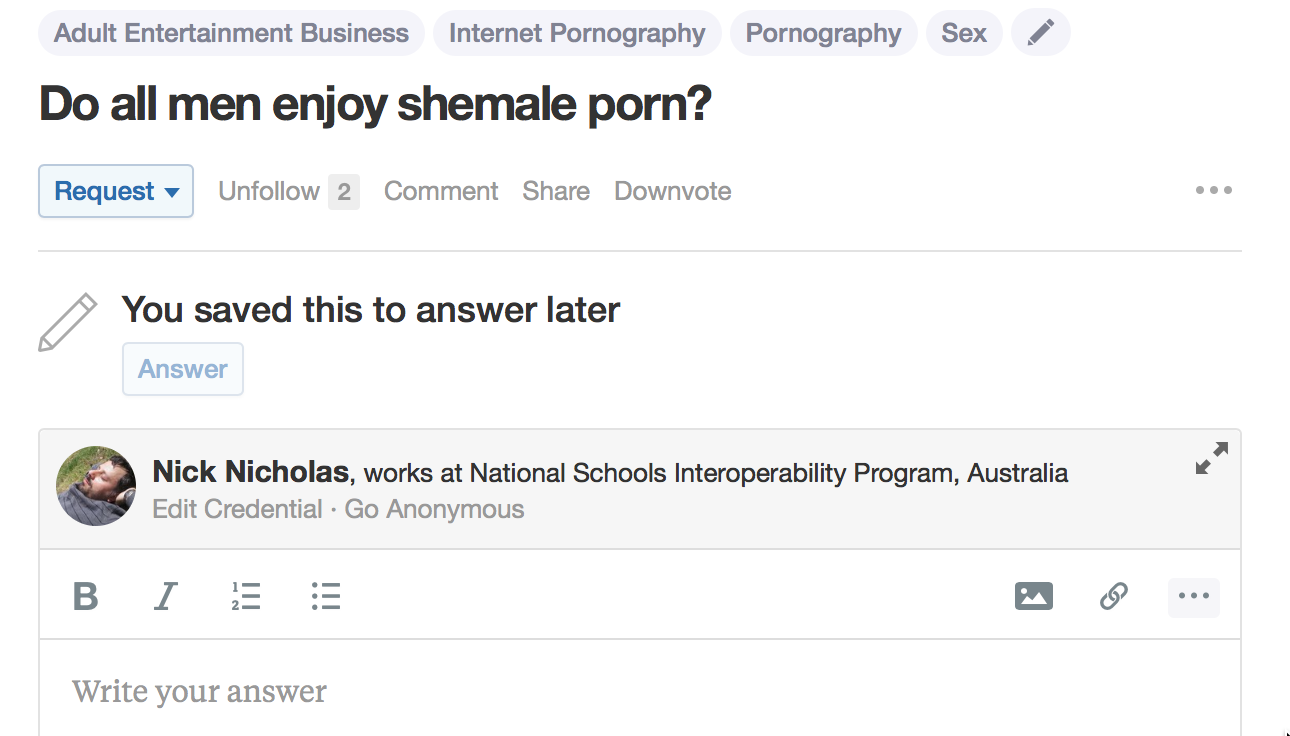
Well, let’s put it this way:

And can you imagine the delighted reaction that would get at work tomorrow!

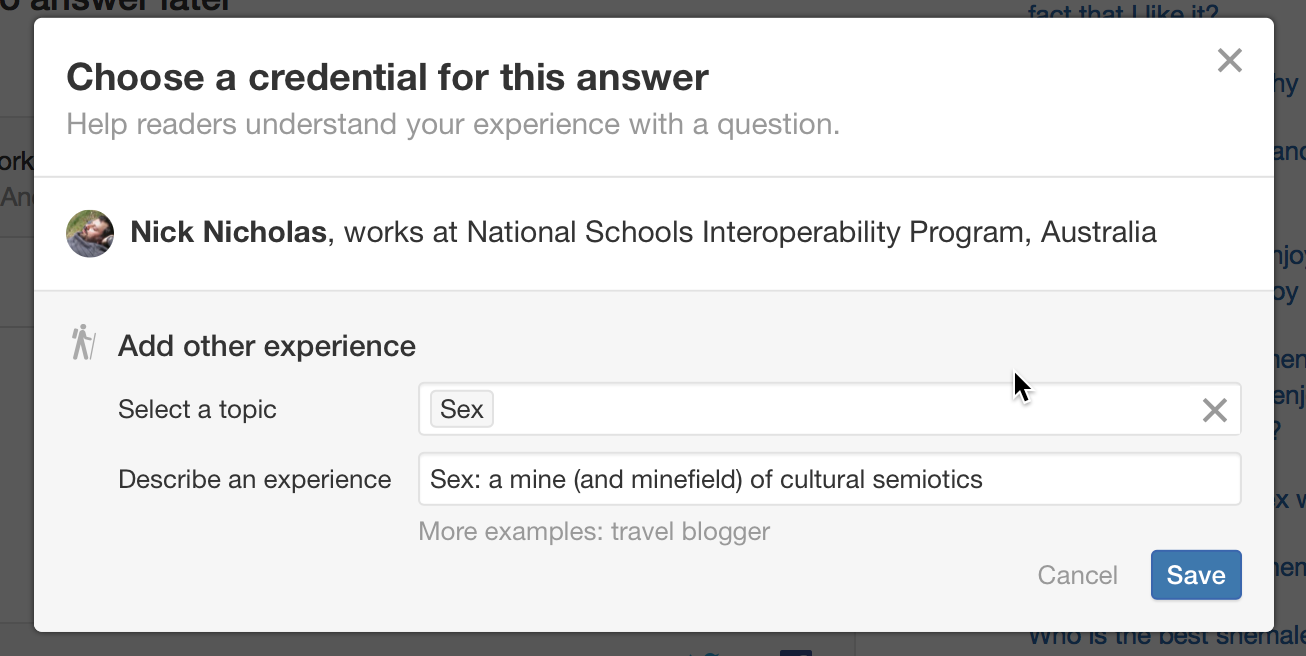
I’m actually shielded from the worse of the new terror of credentialism, because I obsessively bio’d myself about everything I regularly write on. Let us suppose I am adding a new topic to respond to . Well, that’s not as painful as I feared:

But of course, picking a bio relating to the existing topics of a question was not broken, and no, it did not need to break now, and no, I will not scroll through the dozens of bios I’ve built up.

Quora UI. And of course, this is the debugged version, as Peter Hawkins points out.

For my meme on the subject, see: Quora Credentials by Nick Nicholas on The Memes of Production