What is the closest masculine equivalent of “temptress” and “seductress”?

Vote #1 Audrey Ackerman: Audrey Ackerman’s answer to What is the closest masculine equivalent of “temptress” and “seductress”?

A comprehensive answer I will not hope to top.

Audrey has missed one term. She would reject it as a culture specific, literary reference.

But hands up; who knew that Lothario was a character in Don Quixote?

A lot less than know what a lothario is. I’ll concede, not a massively common term; but maybe a touch better than Casanova (which has the whiff of pathology about it for me), certainly more apt than Romeo (I get that from my wife too, but it is pretty jocular, and Romeo was not meant to be irresistible); and Alberto Yagos is right, Adonis is about beauty and not seduction.

Pretty sure stud and hunk have gotten to the literary register by now, surely.

Vote #1: Audrey Ackerman’s answer to What is the closest masculine equivalent of “temptress” and “seductress”?

What would the world (map) look like if every country had to merge with at least one other country and they got to choose?

Such a highly specialised hypothetical, my good Dr Aziz Dida, deserves the soundest of empirical enquiry.

Mercifully, we have for Europe an extremely sound and fairly reliable criterion to answer this question.

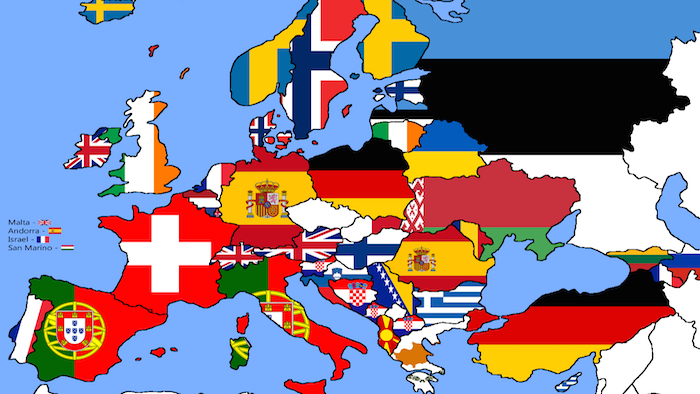
Eurovision Song Contest: A map of the countries most voted by others

Yes, there’s some static caused by large ethnic minorities. Whatevs.

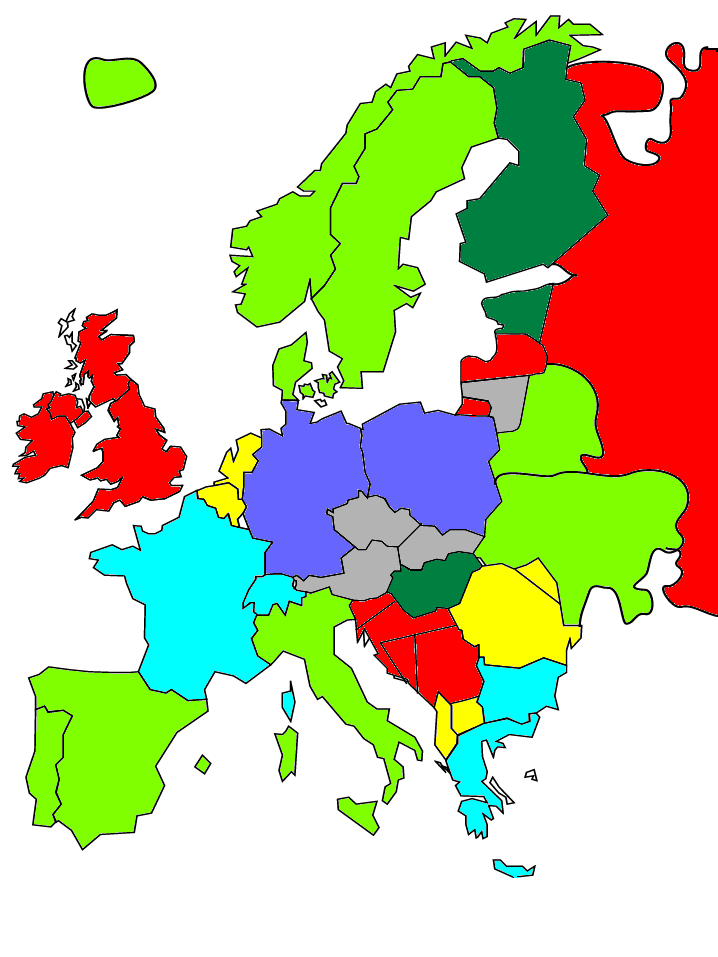
This is my magnificent rendering of Europe loosely based on this. Grey for countries that didn’t really fit. Enjoy the Eurovision Union.

Why was hospitality so important in the Greek world?

My answer is more a gut-feel from Modern Greek practice, but I suspect it applies to antiquity as well. Dimitris Almyrantis perceptively identifies the (or at least an) underlying reason: avoidance of retribution. Cernowain Greenman identifies the surface reason: code of honour.

The modern Greek code of honour (How do I translate the Greek word filotimo?) also prominently features hospitality. The rationale that I intuit for it there is: it’s all about positive Face. If you can dispense largesse, you will be looked on as a valued member of the community: to be honourable consists of doing right by your fellow human, which means not only giving back (reciprocity), but also giving (generosity).

In that light, honour requires that you be hospitable, just as honour requires that you be diligent and responsible. (The reproach for a slack civil servant or a cheating tradesperson is that they are afilotimos, dishonourable.) You do good for others, not because you expect it in return, but because society as a whole benefits from it.

That’s consistent with Dimitris’ answer, which it ultimately derives from, and it’s a modern elaboration of Cernowain’s.

READ: Charles Freeman: A New History of Early Christianity

Amazon.co.uk: Charles Freeman: 9780300170832: Books

One of the few negative reviews on Amazon, by someone offended by Freeman’s secularism, says:

If you are looking for a secular or fundamentalist liberal account of the Early Church, which presupposes that there is very little which needs to be understood about the person of Jesus, and his followers’ convictions about him, then you could do no better than buy this book.

Yup. And that makes it a great read for me.

I’ve read a fair bit on both Historical Jesus and the Early Church, but this account still foregrounded for me a lot, and I appreciated it for that. That includes:

  • The incoherence of Paul’s theology
  • The lack of curiosity Paul had about the actual Jesus the Nazarene (something Nikos Kazantzakis lampooned towards the end of The Last Temptation of Christ)
  • The massive contradictions between the three or four strands of the New Testament (Hebrews vs Romans in particular)
  • The lack of a well-defined orthodox Christian theology for centuries
  • The long-running prominence of Subordinationism in Christian theology prior to Nicene Christianity. (The conventional narrative is of course that the Trinity was there all along to be uncovered; the account of the homoousion as a stumbled-on catchword, which was never really thought through, was a welcome corrective.)
  • The extent to which the first four Ecumenical councils were the products of imperial intervention
    • The Da Vinci Code narrative of Christianity being this unsullied chalice before the Empire got hold of it was one I long found puzzling, with my orthodox (Orthodox) Christian instruction in the Ecumenical Councils. This was the first time I got it.
  • The fact that Leo I could claim much of the credit for the Chalcedonian creed—at a time when the West was otherwise a laggard in theology
  • The closing down of inquiry in the face of orthodoxy
  • How much Jerome and Augustine have to answer for, in their ascetic and pessimistic view of humanity

The most sensational bit of the book is the very early speculation on what happened to the body of Jesus. It’s still an unsettling notion for me—unsettling because it is plausible. But that is a bit of speculation, and it should not distract readers from the rest of the book.

I found myself thinking this would be a particularly interesting read for Muslims. They would get their kicks, I suspect, from the fact that a lot of their polemics against Christianity were live issues in third- and fourth-century Christendom.

One review I’ve found sneered that Freeman is a generalist not a theological historian, and that this work does not break new ground. That does not compel me: there’s a hell of a lot of room in the world for cogently argued summaries of modern scholarship.

READ: Geoffrey Blainey: A Shorter History of Australia

I will also be including in the Aphypnesis blog books and art I have consumed outside of recommendations.

A Shorter History of Australia

Took me a little while to get through, but it is quite digestible.

Geoffrey Blainey has been the doyen of the Old Right Wing of Australian Historiography, and was embroiled in Australian cultural politics on the side of those suspicious of multiculturalism. The history is clearly right wing, but not so much so as to make a left winger fling it across the room.

Given Blainey’s own embroilments, it’s somewhat amusing to see hm visibly forcing himself to acknowledge the Aboriginal perspective on history and the wrongs done against them (even if querulously he still argues the resources should have been unleashed for the greater good), or to resort to “but the Chinese did it too” rather than overtly defending the White Australia Policy—though still defending the virtues of homogeneity. It’s not firebrand bogan nonsense: it’s an intelligently presented, now minority view, which can be debated rather than just shunned.

Because of the caricature stances of the History wars, I was expecting that Blainey would be a stick in the mud, old school practitioner of the Great Men school of history. He really isn’t; it’s all about economic and cultural forces, and the emphasis on economic forces was a pleasant surprise. The Great Men are studiously contextualised, and in fact underemphasised; there’s not much more said about Malcolm Fraser than about his grandfather Simon Fraser (Australian politician).

I came to the book feeling I was missing a lot of Australian history. The book filled a lot of gaps, though I don’t think there were that many surprises in it. Then again, that’s Australian history’s fault, not Blainey’s.

Should “…white males should heartily and repeatedly go f*** themselves,” be considered a violation of Quora’s Be Nice, Be Respectful policy?

This question again? Gawd.

Yes it should, and I’m told it has in fact been dinged by BNBR. Can we move on now?

Are linguists more likely to have a musical background?

Zeibura S. Kathau has a rather more perceptive and fine breakdown on this than I’d hope for; vote #1 Zeibura S. Kathau’s answer to Are linguists more likely to have a musical background?

I’ll just add two observations.

  • Of my fellow PhD students in linguistics, one was a composer and pianist, one a bassist, one an orchestral violinist, and me, who at least attempted to compose once. That’s out of a sample of I dunno, 20.
  • In my day job in Schools IT policy, we have 8 people in the consultancy. Outside of me, the CEO is a folk mandolinist, the CTO a bassist, and the Comms guy a sax player.

So I suspect that musicians don’t just gravitate to linguistics. But I do also suspect that people interested in formal systems gravitate to also working with other formal systems. Though that’s nothing like as thorough an analysis as Z-Kat suggests.

I’ll note a potential counterpattern. There were a fair few refugees from computer science (as it was then) to linguistics in my cohort too; I was one of them. My master’s supervisor observed to me that when computer people came to linguistics, they did not want to do syntax or formal semantics, as she expected. They did the fluffiest linguistics they could stand: discourse analysis, for example, or historical linguistics. If they wanted to do formal symbolic analysis, after all, they would have stayed in computer science.

Has Melbourne been the financial center of activities for advocates of annexing Greek Macedonia to FYROM?

Oh, fuck.

Let’s put it this way. And for the purposes of this answer, I’m going to assert that there is indeed a distinct Makedonski minority in Greece, rather than refer to FYROM overtly.

If you were an ethnic Macedonian living in Florina/Lerin or Kastoria/Kostur, you had the option of embracing a Greek identity and rejecting a Makedonski identity, or of asserting a Makedonski identity.

If you did the former, your motivation to leave Greece for other pastures would be no greater than for any ethnic Greek living in Northern Greece.

If you publicly asserted a Makedonski identity in Greek Macedonia, which included at minimum speaking Macedonian in public, and at maximum advocating the union of your territory with FYROM, your life would be made uncomfortable, to greater or lesser extents. And you would have greater motivation to leave Greece for other pastures.

So a lot of ethnic Macedonians from Greece with a Makedonski national conscience ended up in Australia.

So did a lot of ethnic Macedonians from Greece with a Greek national conscience.

It was not pretty. There were violent disputes within families. The anthropologist Loring Danforth wrote the account of what went down in Melbourne (The Macedonian Conflict), and it’s terrifying. In the ’90s, there was literal bomb throwing on both sides.

The crucial point here is, if you’re an ethnic Macedonian from Greece with a Makedonski national conscience, you are far likelier to be vocal about that in Australia than you are in Greece. You’re also far likelier to spend your money, to support any activities supporting the assertion of a Makedonski national conscience in Greece.

That’s not a conspiracy theory, that’s not even an accusation of anything. That’s just fact.

At the time of the bomb throwing, the Australian media was full of third parties snarling that these people should fuck off back to their own country and fight their stupid battle there. At least one commentator (I wish I remember who it was; it might even have been Danforth) pointed out that there is no battle within Greece: it’s because they were in Australia that they felt free to wage a battle.

Oh, and the “Slavomacedonians” of Australia are my fellow citizens, and I have no beef with them. Even though the beef did prevent me dating one…

Full Disclosure: Victor Friedman, advocate for the Macedonian language and well known bugbear of Greek nationalists, has treated me to absinth in his flat while working in Melbourne. In the eyes of some, that might recuse my testimonial…
How do I identify a militant atheist?

I am blessed to have lived in a country with a state religion—which ends up tantamount to no religion at all—and in an aggressively secular country. So while I may have had the zeal of Voltaire in my teens about atheism, I no longer get, nor particularly care to get, strident atheism such as abounds in the US.

That’s strident atheism, to make a distinction my confrere Michael Masiello makes.

Why not Magister, Michael, as I usually call you? Because this time around, I’m dissenting, and that calls for fraternity rather than tutelage. 🙂

I dissent, because while I understand the distinction made by Michael between atheism and antitheism, it is not a distinction of any great age, and not one I would impose on the question. I haven’t read of the antitheist Soviets, for example, just state atheism.

And of course that’s why I find the notion that militant atheism is inconceivable to be a cavil. Of course there have been militant atheists. If we take the maximalist definition of “militant” used by other respondents, I don’t know what else to call the killing of 28 bishops and 1200 priests from 1922 to 1928 in the name of Leninism (Religion in the Soviet Union – Wikipedia). If we take the less lethal, but to my mind no less valid notion of militancy as the systematic suppression of religious practice and destruction of religious sites, the Soviets excelled in militant atheism as well.

And to my mind, an activist destroying a religious symbol to protest religiosity, still counts as militancy and not just stridency. What Femen did in chainsawing the public square crucifix in Kiev to protest Pussy Riot (Femen – Wikipedia), for example, might have been militant atheism, anti-government protest, or any number of other things. (Mostly, I think what Femen does is simply inane, but I’m not their target audience.)

So if militant atheism involves organised acts of actual violence against believers (if you want to differentiate militancy and stridency in that way), is that a current issue? If it is, it’s mostly limited to North Korea, China, maybe Cuba. And to tell a militant atheist, you’re looking for the willingness of the atheist to commit violence to advance their agenda.

Does that excuse belligerence and contempt, from either side? Not in my book. YMMV.

Go in peace.