When and how does semantics meets phonetics?

Good question, Anon!

By design, they’re not supposed to. Linguistics makes a point of segregating them hierarchically:

  • Phonetics: how individual sounds work
  • Phonology: how sounds are organised into meaningful contrasts as phonemes
  • Morphology: how phonemes are organised into meaningful components of words as morphemes
  • Lexicon: how morphemes are organised into meaningful words
  • Semantics: how the meaning of those words works.

The hierarchies are more leaky than we would like; they are convenient abstractions. There can be leakage between them. But by asking for semantics to meet phonetics, OP, you’re asking for an awful lot of leakage.

The closest I can think of is morphophonemes, which leak between phonology and morphology. Plural -s, for example covers both [s] and [z]. The two are clearly different phonemes of English now (though they didn’t used to be). You could argue that the neutralisation of contrast between the two in that context means that there is a single morphophoneme at work, -S, spanning /s/ and /z/. Enough of that kind of thing happens, through diachronic leakage, that Morphophonology is a thing.

That’s a bridge between morphology and phonology, anyway.

EDIT: Forgot to put in another leak: Sound symbolism. Phonemes are associated with particular vague vibes of meaning, and accordingly get used with naming particular concepts. It’s vague, it’s infrequent, it’s not reproducible (little sounds little, but does small?), and linguists usually get away with ignoring it outside the most explicit instances, in onomatopoeia. But it is a leak of some meaning from semantic classes down to phonetics.

Why was a Greek city with the name Mαρωνεια written Marogna in Latin and not Maronia?

As far as I can tell, you are referring to Maroneia in Thrace, and the rendering Marogna appears in Smith’s Dictionary of Greek and Roman Geography (1854)

Maroneia is reckoned among the towns of Macedon. The modern name is Marogna, and it has been the seat of an archbishopric.

Cramer (1828) also gives the name of Marogna (A geographical and historical description of ancient Greece), citing a P. Mela.

I don’t see any evidence for Marogna being Latin; it is an Italian rendering of /maronja/ (Greek Μαρώνεια Bulgarian Мароня), and is presented as modern explicitly. With Italian mariners having the run of the Mediterranean, it would not have been unusual for a port in Greece to have an Italian rendering, or for the early 19th century rendering of a Greek (or Bulgarian) placename to have been spelled via Italian.

How do you adjust your question when Quora sends you the vague notification that “this question needs improvement”?

This is more about others’ questions I find than my own, though I occasionally get dinged by the FormatBot myself.

  • Always end the question with a question mark. No, don’t follow it with a parenthetical remark
  • Correct Spelling
  • Correct Punctuation
  • Correct Spacing
  • Boring Punctuation. The FormatBot is a simple beast. Don’t do anything creative with punctuation. If you’re going to cite words or letters, for example, don’t use quotes. Just italicise them.
  • If all those fail, I dunno, keep rephrasing it until it stops. And make the rephrasings progressively dumber and dumber until it does. The more cookie-cutter the syntax and punctuation, the less the FormatBot will find to object to.

I don’t actually hate the FormatBot anywhere near as much as the other bots roaming around here. In this particular context, it does less harm than good: simpler questions are less likely to be Special Snowflake questions.

What are some similarities and common things that Greek has with Arabic?

Commonalities between Greek and Arabic?

They belong to different language families—Indo-European vs Afro-Asiatic (which includes the Semitic languages, which also includes Hebrew and Phoenecian); noone has proven a more distant relation between the two.

The alphabet of both derives from Phoenecian; hence the similarity in letter names to this day. That also extends to Hebrew: aleph, alif, alfa.

A few loanwords from Phoenecian in Ancient Greek; like arrabon “pledge” (and later, engagement).

A few more loanwords from Hebrew into Koine, through Christianity, like satanas and amen.

A fair few loanwords from Greek into Arabic, via the transmission of the Classics and Greek science and mathematics.

A few loanwords from Arabic into Greek via contact during Byzantium. (e.g. magazi “shop”, maimu “monkey”).

A fair few loanwords from Arabic into Greek via Ottoman Turkish. e.g. musafiris < mısafır < mosâfer “guest”.

Pretty sure me “with” isn’t one of them. OTOH, me Albanian and Modern Greek are considered cognates.

Who are some famous people who annoy you for some or no reason?

Permit me, Quorans, to introduce an Antipodean personality into this thread of woe.

Permit me also to try and comprehend why we have this annoyance for no (or least no rational) reason.

I mean, if you’re not from Australia, this chap looks unexceptional, doesn’t he?

Raffishly unkempt, perhaps. Glasses; he could be studious! A computer in the background: might he be in IT? On a mobile phone: must be always on the go. Looks to be in his fifties: surely not an age bracket anyone can take offence to.

OK. Australians, don’t say anything. That’s my job, it’s my answer.


So. Let me pitch you a story.

A young carpenter by the name of S. Caminetti, travelling the country, from sheep station to dockland, settles down in his native Sydney, marries and establishes a successful building business. It is the Australian property boom, and business is good.

He is affable and charming, with all those virtues Australians appreciate in their tradespeople—those they call sparkies (electricians) and chippies (carpenters) and brickies (bricklayers) and dunny divers (plumbers). And somehow, ten years into his successful building business, he ends up doing building segments, during a lifestyle show on Australian TV.

He’s a hit. The public loves him. He gets a series of TV shows that rotate around building and renovations (now an Australian craze). He gets sponsorships from sundry building-related enterprises. He refuses to let his unlikely fame get to him: in fact, he famously makes a bottle opener out of his Logie Award (the Australian counterpart to the Emmy).

Why on earth, Nick Nicholas, you horrible heartless inner-city effete snob, would you despise such a man? Why would you put your hands over your ears and demand that S. Caminetti vacate your sight, whenever you flick past a show with his whimsical stylings?

Mm?


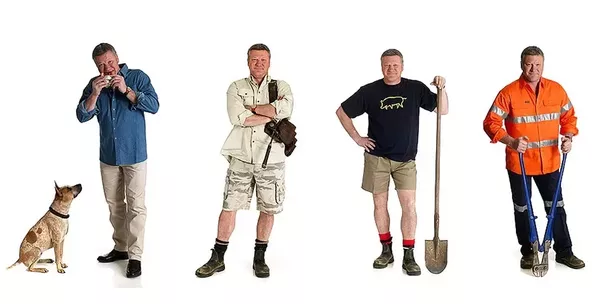
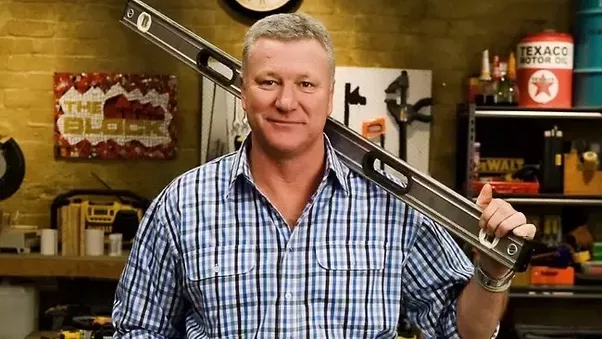
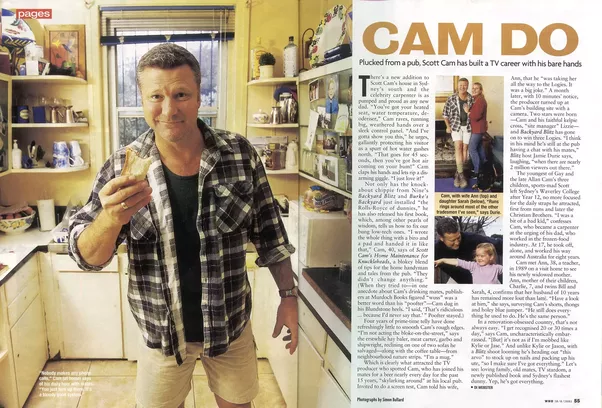
Perhaps these images can begin to convey why:

Scott Fricking Cam. Take your blokey bloke hijinks, Scott Cam, and your shit-eating grin, and your bogan tradie antics, and your endless succession of Ocker reno reality shows that all look the same, and your one-man bolstering up of an entire TV network, and your smug condescension, and your banter with your irritating reno reality show contestants, and have I mentioned that god. damn. shit. eating. grin; and get out of my sight.

NOW!

Fuck me. As if I didn’t have enough reasons to hate Sydney already.


EDIT: I realise, in the torrent of my rage, that I forgot to explain why we hate these people.

As you can see from the images: it’s the overexposure. And the bombardment of media telling you you must. love. this. person.

No, pilgrim. No I must not.

Who are the linguists and language teachers on Quora?

Reporting in.

No longer an academic, but I have a PhD in historical linguistics, and I published over a decade. Mostly in Greek historical linguistics. I also do some computational linguistics, although I’m not sure that’s counted here.

Symposium at Dimitra’s

According to which criteria would you name objects and concepts?

I suspect, from your other questions, Gabriele, that you’re interested in a non-arbitrary, logical framework for naming things.

If I’m right, anyone that knows anything about language will tell you it’s a chimera. But most interesting things are.

Your question (if I read it right) is reminiscent of the attempts at a Philosophical language and/or Pasigraphy, such as Wilkins’ An Essay towards a Real Character and a Philosophical Language. They rely on an ontology covering everything in existence; and because of AI and Natural Language Processing, Upper ontologies are now a thing.

Your criteria for naming objects and concepts then become the criteria for your ontology of the universe. And even if it’s chimeric, that effort is going to be quite rewarding. More rewarding than a pasigraphy.

It could be, of course, that I’ve quite misconstrued your question…

Can I get a Greek tattoo when I’m not Greek at all?

I live in Greektown, Melbourne. Which means I see a lot of Greek tats sported by Greeks. And I do plenty of looking down on the cookie cutter nationalism of biceps with inked Molon labe, and Maeanders that look a little too close to swastikas. But of course, I’m a cultural conservative, so I would say that.

You will have something more imaginative than that, right?

Tats aren’t a Greek thing traditionally, so Greeks won’t feel like you’re “culturally appropriating” anything (that’s a peculiarly American thing). And Greeks in the diaspora will think it’s a Frankish (Western) thing to do.

Of course, plenty of off-the-boat Greeks here in Greektown sport tats: unlike the diaspora, Greece itself is now part of Frankia (the West).

Like others have said, Greeks overall, diasporan or not, will tend to be flattered that you like their ancestral culture enough to get it inked. So long as it’s spelled correctly and thought through, of course—because otherwise, it’s just a dis.

Does word gerokronoliros (γεροκρονόληρος) contain non-Greek (borrowed) elements? What is its meaning and etymology?

I checked LSJ: no γεροκρ- anything. And there wouldn’t be: γερο- for “old” is Modern Greek, the Ancient Greek would be γεροντο-.

I googled γεροκρονοληρος, as Dimitris Sotiropoulos suggested in his exchange with Konstantinos Konstantinides.

The good thing about Google, is that it assumes you misspell things. So it tries taking words apart.

I didn’t guess what κρονόληρος means, which does me no honour, because when you see it in context, it is obvious. (And god knows Dimitris dropped enough hints, in his Quora Jeopardy!)

Κρονόληρος – Βικιλεξικό

Used by Plutarch to refer to an “old twaddler”, a foolish old man. From Kronos, Cronus (Roman Saturn), father of Zeus and a proverbially old god; and λῆρος, (originally) “gaudy”, (eventually) “delirious, silly”. (Modern Greek speakers will recognise it in παραλήρημα, “babbling, nonsense”.)

The etymology of λῆρος is uncertain, but it may derive from a Boeotian word for a gold ornament on women’s tunics.

So: “delirious Saturn”, of a foolish old-timer.

Now. Dimitris reports that:

It was in a phrase with a Description for a neighbor in the village

So what is a modern Greek prefix doing on a word used by Plutarch?

Someone in your village in Greece, Dimitris, had a classical education.