If a Turkish Cypriot is a Christian, does that make them a Greek Cypriot?

Under the millet system, which is still recent memory in former Ottoman countries, creed was the determinant of identity. If you were Orthodox you were Rum/Romios, if you were Muslim you were a Turk—no matter what your ethnicity, and what your main language was.

So a Greek Cypriot that converted to Islam 200 years ago was deemed a Turkish Cypriot. The penalties on apostasy from Islam were in full force, but yes, if a Turkish Cypriot converted to Orthodoxy, he would be deemed a Greek Cypriot. And many Turkish Cypriots would have spoken Greek anyway.

That kind of thinking was done away with in the 19th century through nationalism; and there wasn’t a lot of precedent for conversion to Orthodoxy anyway (though the Orthodox church does commemorate the few such precedents as martyrs). So now, the answer is no.

Is it possible to fry eggs in water? if I wonder how to do it, why quora collapses my answer?

In a small-minded, robotic reading, I can see why this was deemed as not answering the question.

What’s happening in reality of course is that both the question and answer are in poor English (I’m sorry, but they are), so one needs to think a little to understand what is going on. And Quora Moderation does not always display a sympathetic approach to poor English.

The implicit question was: if frying eggs in oil or butter is bad for you, would removing the fatty oils from the process (e.g. filling a frying pan with water instead of oil) be better for you?

That’s not what the question said, but it’s what it seems to have meant. And OP eventually adjusted it to “Oh, you call that poaching in English.”

Your answer is “frying eggs is not bad” (well, depends on bad, because consuming lots of food fried in oil is considered bad for you for a reason), but “frying in water is impossible”.

That doesn’t answer the question, because it rejects that the question even makes sense. There are plenty of answers like that here.

I *think* what’s happened here is that the moderator thought the implicit question did make sense (because it was speaking about the harmfulness of oil, and whether removing oil from the process would make a difference), and that you didn’t address it.

I don’t agree with that call; it is, in any case, speculation. Poor English will prejudice readers, especially if there is some difficulty in recovering the meaning. I will say, though, that I didn’t think your answer particularly ambiguous.

Is it rude for Quorans to ask you to answer a question and then not upvote your answer?

The way I see the world, it is noticeable not to acknowledge someone acting on your A2A. Human beings function that way. Quora may think they are above human sociability (which is why they keep denying that this is also a social site). But Quora users are not.

I don’t obsess about every upvote, but I will certainly notice it if noone upvotes an answer I’ve given—including the A2A’er. And I will read something in to that.

What form should the acknowledgement take? Well, there are multiple forms, and there is widespread confusion about exactly what the Thank button is for (How many of you use Quora’s “Thank” function after reading a good answer? Is sending “Thanks” without upvoting kind of like a backhanded compliment on Quora? What is the difference between sending “Thanks” and agreeing with/upvoting an answer on Quora? These features seem kind of similar.) My own behaviour, like Edward Conway’s, is to reserve Thanks for very good answers.

Is there a clinical term for a “shart?”

Thanks for A2A… I think.

From Fecal incontinence – Wikipedia, the closest I’m seeing is fecal leakage. But that doesn’t have the implication of controlled but misconstrued bowel movement that a “shart” has.

Googling is not yielding a more formal term.

Is there any way to sort users by the number of answers and their quality when using the “Request Answers” feature?

Would be nice, wouldn’t it. I’m not aware of one.

Quality of course can’t be gauged automatically, but the request answers popup doesn’t even bother telling you who the Most Viewed Writers are, let alone sort them accordingly.

Oh, but it does show you their bios. Which are now credentials. That should tell you something…

Quora deleted a private message I was writing as “unsafe” because it contained the word “stupid”. How do I get it back?

I can confirm Edward Conway’s answer, as I was who he tested it out with.

I was surprised that moderation can not only scrutinise but edit PMs, but Nikki Primrose has just reported the same experience: I received a notification that I’d violated BNBR but the link was to a message in my inbox that I’d never replied to. What is that about? She got Benburred (h/t La Gigi) for receiving an offensive message (?!), but her correspondant got his message removed from her inbox.

My first surmise is that someone reported you, but..

… OP, this was happening while you were typing? That sounds… draconian, and unmanageable. And it certainly doesn’t sound like a reaction to a report. It does sound extraordinary that people’s PMs should be prefiltered, especially for something relatively innocuous.

I don’t know that you can get it back; but an appeal to mods is always worth trying.

Yes, Shashank, I know. 🙂

In Classical Greek diphthongs, was the first or the second element accented?

I finally worked this out, by reading half of Ancient Greek accent – Wikipedia. (Reading the other half confirms it, but I’m still proud of myself.)

The answer is: the second element if acute, the first if circumflex.

Let’s take this slow.

The explanation of the distinction between acute and circumflex in the Wikipedia article is based not on contours on a vowel, but on high/low contrast on Morae (what a long vowel has two of, and a short vowel has one of). And I gotta admit, that’s the first time an explanation of Greek accent has made sense to me.

So. Let’s ignore grave. Short vowels can only take an acute. That is a high pitch on a single mora:

έ = ˥e.

A long vowel can take an acute. That is interpreted as a high pitch on the second mora:

ή = ɛ˥ɛ

μή = mɛ˥ɛ

You’re going from neutral pitch to high pitch. That will of course sound like rising pitch.

A long vowel can instead take a circumflex. That is interpreted as a high pitch on the first mora:

ῆ = ˥ɛɛ

In context, a circumflexed vowel is a neutral pitch mora, followed by a high pitch mora, followed by a neutral pitch mora; e.g.

καλῆτε = ka.lɛɛ.te

That will sound like a circumflex: rising then falling.

So. Diphthongs involve two short vowels. (There’s also long diphthongs, which are the things with iota subscripts.)

Two short vowels are two morae.

So it’s the same. αί has high pitch on the second mora (i.e. second vowel):

αί = a˥i

αῖ has high pitch on the first mora (i.e. first vowel):

αῖ = ˥ai

Now, your question was, if we use contour tones rather than pitch peaks, how do we transcribe it in IPA?

At that point, I myself would prefer to just go with convention, and put the contour tone symbol on the second letter, because that’s what Greek does. But the point here is that the contour tone, in both cases, starts on the first vowel = first mora. So arguably putting it on the first vowel is more accurate.
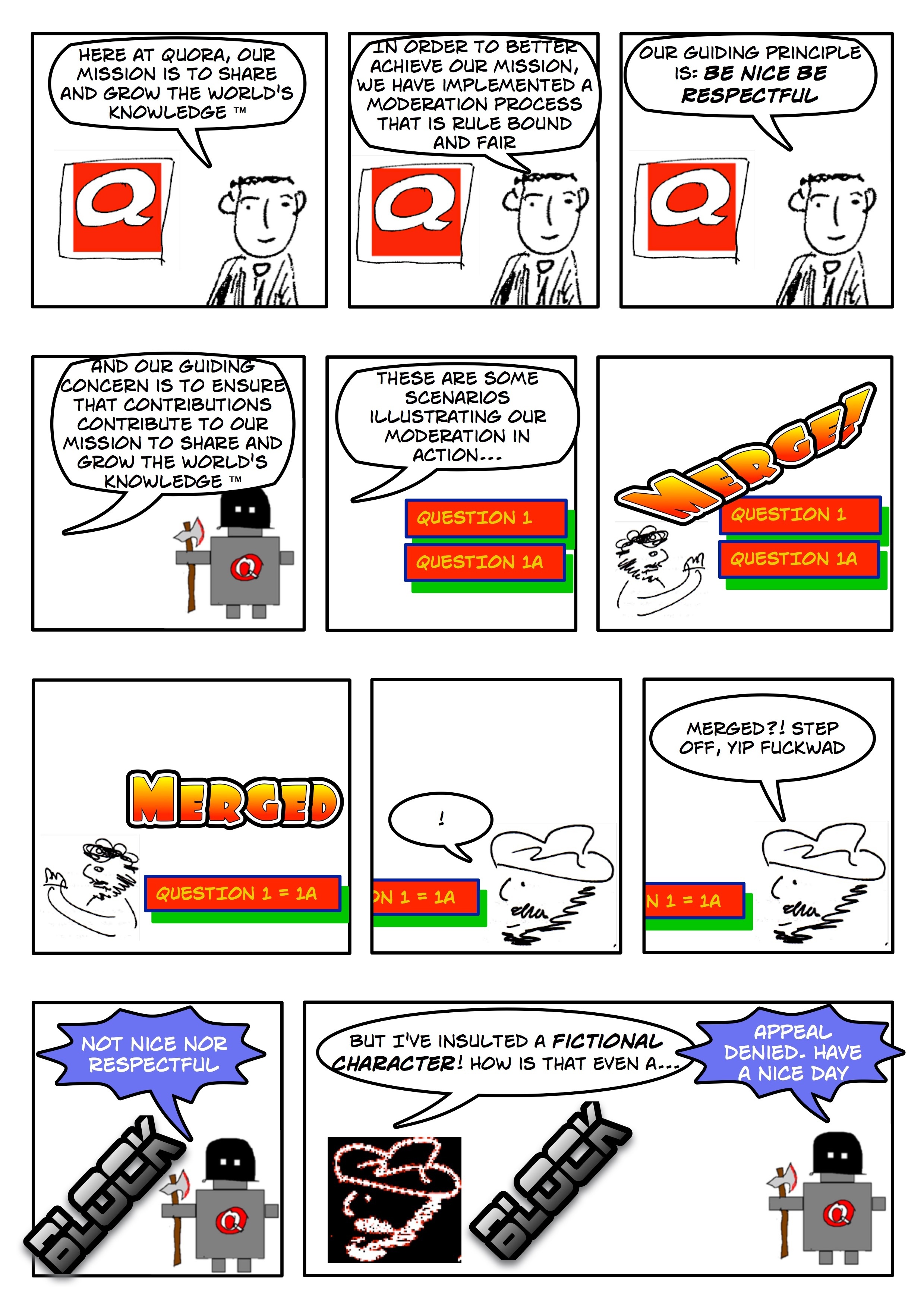
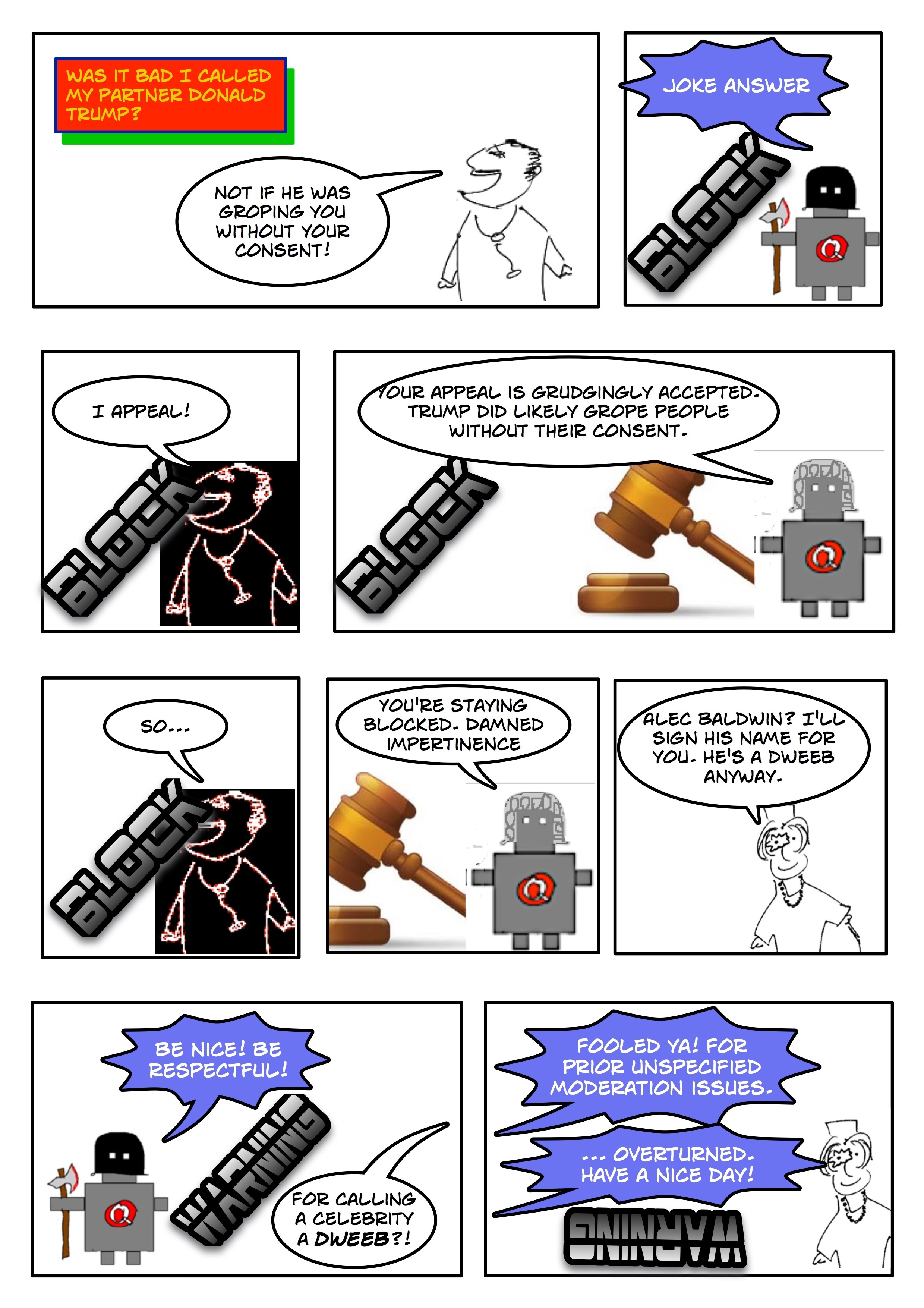
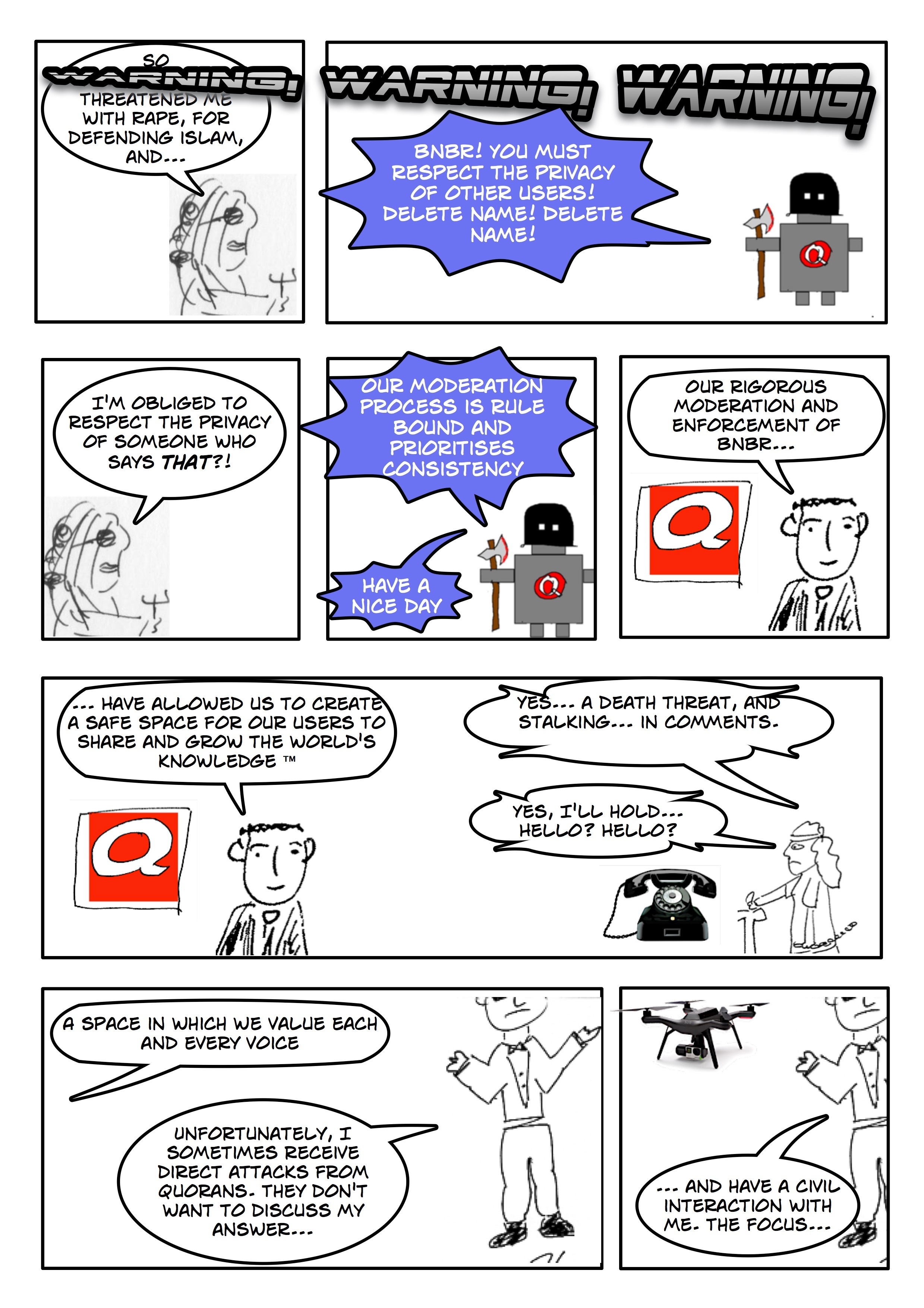
What are some good rage comics about Quora?

Not quite in the Rage Comic genre, but I’m rather proud of what I came up with as a lowercase rage comic in this post:

Nick Nicholas’ answer to Do you believe Quora moderation is doing a good and responsible job of maintaining this site’s policies? Why or why not?

What is the difference between Erasmian & Reconstructed Ancient Greek?

I gave a sketch here: Nick Nicholas’ answer to What are the pros and cons of the Erasmian pronunciation?

Erasmian is an early reconstruction of Ancient Greek. Compared to our current reconstruction, it’s not as distant from modern Western European languages, and it gets modified for ease of teaching in different countries.

Erasmian as taught tends to make the following concessions. (Happy to be corrected.)

  • Usually stress rather than pitch accent
  • Often fricatives rather than aspirated stops
  • Nativisation of diphthongs
  • Some distortions in the German version
  • Even more distortions in the French version