Yes. In fact, Melbourne is a stronghold of the ’Ndrangheta, the Calabrian Mafia: Honoured Society (Australia). Their main business these days is drugs. They will turn up in the papers maybe once a year.
There was also the spree of Melbourne gangland killings from 1996 to 2010, in which the ’Ndrangheta was only one of six participants. (If only the papers were as clear in their explanations at the time as Wikipedia is now.)
I mean, I love the fact that Implicature explains so much about language change and information transmission; Speech Acts are a great framework for making sense of how language is used to influence people; and Gricean maxims undergird so much of how humour works. But practical?
The closest I can think of (and it is, in fact, pretty practical) is pragmatics as the theoretical underpinnings for much of our understanding of cross-cultural communication, by giving us a way of making sense of how and why different cultures communicate differently. Politeness theory in particular, which is at the interface of pragmatics and anthropology, really helps you intellectually to not find other cultures swinish.
I also don’t like singling out some people as more special than others. But, overwhelmed as I have been today by the question about me, I feel that I need to say—once again—that there are people here who I have bound to myself tight.
I am not making this a huge list, and I don’t want people left out to feel left out; but the question is asking something specific. So.
You know those old cartoon depictions of an angel on one shoulder, and a devil on the other?
These guys are both angels for me: both set for me standards of behaviour to admire from afar, if not to emulate. One just gets the devil role because of his A2As.
McKayla Kennedy. Jeremy Markeith Thompson. They followed me within a day of each other. I got a chill seeing both of them follow me. I thank them for who they are. And they are less dissimilar than they might think. They both have a quiet, considered, decent integrity to them, that I am glad has not passed from the Earth.
There are many people I smile at with recognition and kindliness, whenever I see them here. A few more than most.
Manos Eleftheriou, the guy who actually deserves the Nobel prize for song lyrics, got together with that old misery-guts composer Stavros Kouyioumtzis, God rest him, and that whiny-voiced singer of self-important songs George Dalaras (yes, I love all three); and they did a song I heard at 13, and which (like so many songs I heard in my teens) has stayed with me.
https://youtube.com/watch?v=MyB_ZoYDRuA
You spoke a kind word and I kneeled to the ground and the rock gave forth water for my soul to drink.
Whoever sings of pain will not perish in this life and one friend in the world will stand by him.
These people have stood by me as I have sung of pain, and spoken me a kind word.
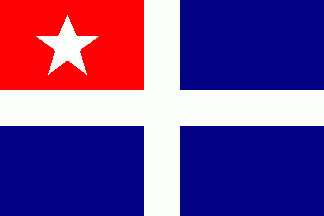
One from the Muslim Cretan tradition (tabahaniotiko), that somehow ended up staying behind after the Muslims were expelled, and whose title is now painfully topical.
It is now sung to these couplets:
Τα βάσανα μου χαίρομαι, τσι πίκρες μου γλεντίζω, κι αν με ρωτάτε για χαρές, εγώ δε τσι γνωρίζω
I rejoice in my torments, I celebrate my bitterness. And if you ask me about joys—I know them not.
I’ve posted about this song a fair bit at Authenticities and Cretan Musics. Here’s a recent performance, of the expansive, dramatic style I love:
And here’s six versions of the song, Turkish, Rebetiko, and Cretan:
The traditional name of the tune? Khalepianos Manes. The Aleppo Plaint.
Song 3
Stars, scold me not.
Stars, scold me not, for singing late at night. My heart did ache (my tall brunette), so I came out and spoke.
I’ll tell the stars my pain: they’ll keep their secret. The stars will wait (look how you’ve left me!), and hear me out for hours.
Song 4
Ok, not song, but dance. The pidikhtos, the Jumping dance.
Crete does not do joyful. It does manic. And it does it like this:
Song 5
Why Crete does manic and not joyful. Because its de facto Subnational Anthem is a song about killing everyone in your rival clan.
When will it be a starry February night.
When will it be a starry February night, so I can take my gun, that fairest matron, down to Omalos, and the Mousouros’ road: leave mothers without sons, wives without husbands, and make young babies cry without their mothers: crying at night for water, at dawn for milk, crying at twilight for their poor dear mother.
It’s a risky question to ask a Greek, because the Turkish that has ended up in Greek is not quite the Turkish of Turkey (let alone the Azeri of Iran and Azerbaijan).
Superficially because it’s Balkan Turkish and not Anatolian Turkish; that’s why every Greek ever will say kardaş for ‘brother’ when trying to speak Turkish, which is Balkan for kardeş, and not quite arkadaş ‘friend’ either.
Also because there is an emotional loading to the words which is absent in Turkish—where they are just words. In Greek, they are often obsolete, dispensed with in neoclassicism; or they are vulgar; or they are pejorative; or they are homely. But they are (now) never just blah. In American English, the closest equivalent might be Yiddishisms.
As an example I ran into recently: if you want to insult the state, you don’t call it just kivernisi (cognate with cybernetics) or kratos (Ancient Greek for “strength”). You use the Italian guverno (as I have, though that’s pretty much dead)—or the Turkish-derived dovleti. And that last one bites. It’s saying Tsipras is running an apparatus little better than an Ottoman outpost. (And the Ottoman outpost would be more efficient.)
And finally, because the words have twisted and turned in their meanings, not just their colouring.
I’m going to go with khuvardas χουβαρντάς [xuvarˈdas].
Ultimately, it comes from Persian خورده khwārdā, “eaten away”. In Turkish, hovarda is about someone who eats away their savings: profligate, dissolute—someone who wastes their money. And by association, someone who wastes their money on immorality: rakish, licentious, raffish, riotous, playboy.
Well, that’s not what a khuvardas is in Greek. In Greek, it is high praise, even if in an admittedly profligate country. It is someone generous, who scatters money like joy to their companions and their community. Someone who appreciates the finer things in life, and is not afraid to pay for them. Someone you respect for how they make their money count for something in this life.
Thinking about this, it occurs to me that the Greek and the Turkish words really are describing the same character trait—from an utterly different perspective. And I know the rest of the EU, for once, side with Turkey on what the word should mean.
But myself, I have always thought of khuvardaliki (“khuvardas-hood”, Turkish hovardalık “profligacy”) as a virtue. As something that gives joy to others, and gives joy back to yourself.
and a now retired Cypriot soccer player (born 1973).
Oh, and then there’s some guy on Quora.
Some guy who now finds himself in a conundrum.
Arrogant enough that I’ve been planning for months to write a series of blog posts here on who I am, in my various guises—partly as therapy, partly as advertising. And that’s still going to happen, people.
And yet humble enough that I actually cried when I saw this question. And I will not, NOT be A2A’ing people for what they think of me.
If, OTOH, any of you should feel like A2A’ing people, well, who am I to stop you.
Who am I? The answers by the others capture a lot of it, and I appreciate them. To my core. I’ll comment on each answer offered, but not yet: I’m still rather overwhelmed.
Here’s my take. And yes, each statement in this decalogue will end up a blog article.
I’m Greek-Australian.
I’ve trained as a linguist, and I have done computational linguistics stuff.
I work in schools IT policy.
Long history of engagement with artificial languages.
I’m a middle-aged cishet man, recently married, no kids.
Loud as a poor coverup for shyness, and with one’s usual share of psychological baggage.
The cliche I’ve heard is the Dutch. As in, the Dutch speak English better than most English people do. But the English of most Western Europeans is exquisite.
Notice the delicious Newspeak of it. Do you think more people have power around moderation now than in 2014?
Moderation clearly involves an initial tier of bots, an end tier of Quora employees, and (we hypothesise) a middle tier of outsourced contractors with questionable command of the English language.
Painstaking attention, giving the benefit of the doubt, and debate may have been the hallmark of the volunteers back in the day (as they have themselves said), but it was not going to scale. Quora has therefore scaled up moderation on the cheap. The end tier of Quora employees as mods is expensive, and is used sparingly.
The less visibility of moderation processes from the outside, the less people have something concrete to attack back with.
The less detail you give people on why you’re moderating them, the less likelihood they’ll have something to protest back at you with (increasing your workload), or that they can take with them to some other site (embarrassing you with your own words).
Makes sense to me, anyway.
It is only recently that we have seen explanations for why people have been banned at all in their logs. That’s a glimmer of transparency which does not make me optimistic per se, but which I welcome none the less.