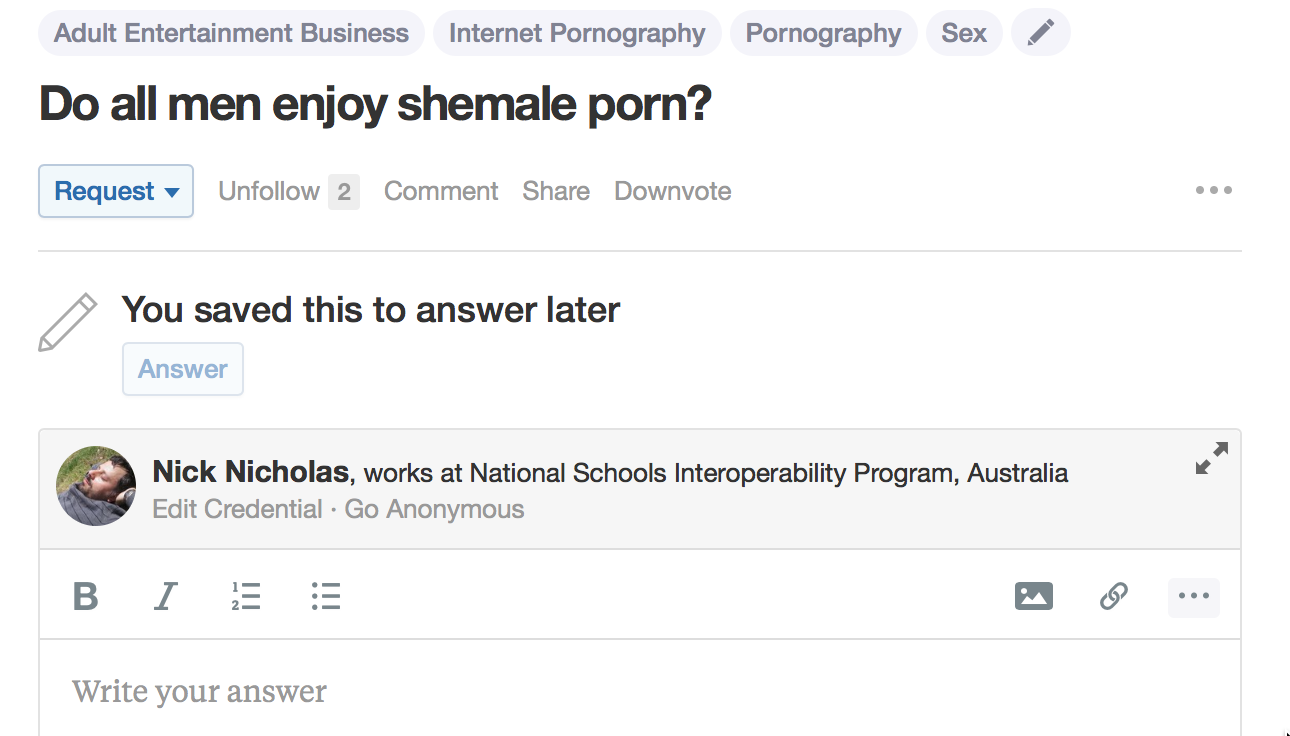
Do you like Quora’s new “credentials”?

Well, let’s put it this way:

And can you imagine the delighted reaction that would get at work tomorrow!

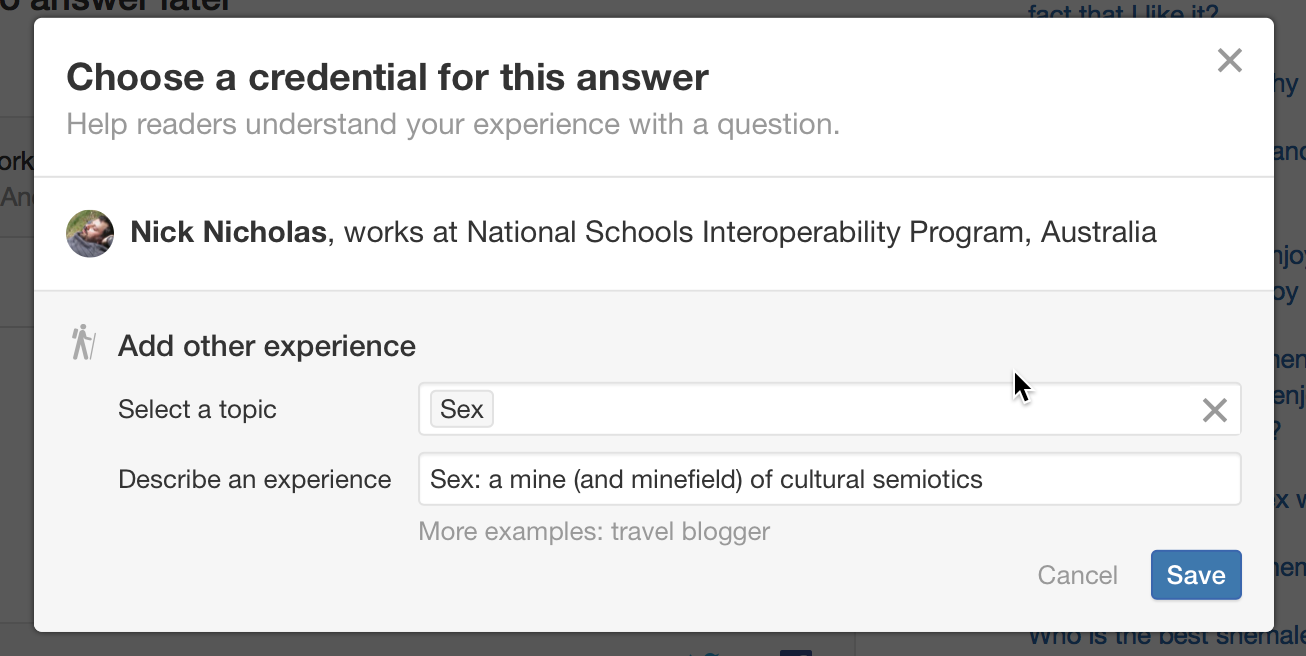
I’m actually shielded from the worse of the new terror of credentialism, because I obsessively bio’d myself about everything I regularly write on. Let us suppose I am adding a new topic to respond to . Well, that’s not as painful as I feared:

But of course, picking a bio relating to the existing topics of a question was not broken, and no, it did not need to break now, and no, I will not scroll through the dozens of bios I’ve built up.

Quora UI. And of course, this is the debugged version, as Peter Hawkins points out.

For my meme on the subject, see: Quora Credentials by Nick Nicholas on The Memes of Production

Does the phrasing of non-trolling Quora questions influence the negative/positive tone and direction of your answers? If so, how?

If the question is not trolling but is still polemical, and I disagree, then part of my answer will be dedicated to dismantling its assumptions. And I might make an aside at the OP.

But there have been many seemingly silly questions, for which I have given serious answers. I like to treat them as springboards.

How do you translate “blockchain” and “bitcoin” to Latin?

This won’t be good, for the reasons Alberto Yagos said.

The Greek for bit is: Bit – Βικιπαίδεια. Of course. There is a Hellenic coinage recommended by the Greek Standards Organisation: δυφίο dyphio[n], from dyo “two” and psēphion “digit”. The Ancient Greeks didn’t do portmanteaux, which is what this is; but if you want a Hellenic bit, that’s what’s on offer.

So you *could* go with dyphionomisma, where nomisma is a coin.

But honestly, Bitcoin shouldn’t be translated, not only because it is anachronistic, as Katharina Sikorski argues, but because it s a proper name, not a generic term.

Blockchain? I would do back to literal rendering. Chain of ledgers would be Catena Calendariorum—where a calendarium was not originally a calendar, but a ledger. You could say that the calendarium is virtual, but really, Catena Calendariorum is plenty long already.

How often do you use the “Asked By People You Follow” feature when answering questions on Quora?

Like others, I’ve only noticed it this past couple of days.

I get questions from A2As, from my feed, and from questions that people I follow answer. I don’t anticipate using it that much; my followees are pretty disparate, and the people I share interests with are not shy about A2A’ing me.

What is your opinion of Noam Chomsky?

Feh. Screw that guy.

I wrote why on my website, something like 20 years ago (ignore the update date): Anti-Chomsky: English. I was somewhat aghast around 2000, when David Horowitz got in touch with me, asking for permission to quote me.

I don’t spend a lot of time thinking about him. (Chomsky, I mean. But not Horowitz either, for that matter.) But:

  • Chomsky was necessary in the 1960s, for introducing the study of syntax into linguistics.
  • Chomsky had a destructive influence on linguistics, by creating a monoculture of linguistic inquiry in the American East Coast and Europe.
  • The things Chomsky & co find interesting about language, I don’t. In fact, noone in Australia does, outside of the University of New England.
    • Chomsky came to town in 1995 and visited my department; I was a vacation scholar at the time in Sydney, and saw him there instead. All my profs had lunch with him. And they couldn’t think of a thing to say to him. They were fieldwork linguists, after all.
  • His theory of language sounds tenuous to me. It may not lack explanatory adequacy, but it certainly lacks explanatory oomph.
  • Politically, he says the kind of things that comes as a revelation to an engaged 20-year old. And, regrettably, attracts the kind of cult of personality that 20-year olds are prone to: there’s a graffiti mural of him on my way to work. To a jaded 40-year old, they’re a mix of “yeah, so what?” and “God, could you be any more naive?”
  • As a polemicist, both in linguistics and politics, he’s an objectionable so-and-so, who defines his interlocutors away.
  • As a writer, he’s an obfuscator. The Chomskybot has a lot more.

Why does the Greek Orthodox Church have religious hegemony in Greece?

Start with Byzantium: Orthodox Christianity was the state religion, and heterodoxy was deemed treason. Jews and Muslims were tolerated in Byzantine Law as second class citizens; heretical Christians got the sword.

In the Ottoman Empire, that continued with the Rum millet: Greek Orthodoxy defined the nation of Romans, which was considered to include Greeks. Catholicism was a minority presence in Greece, and Greek Catholics were deemed not Rum (Romioi, Romans), but Frenk (Frangi, Franks).

When the Modern Greek State was founded, Orthodoxy became the state religion quickly; and it was considered coextensive with Greek national identity. That has allowed it a hegemony that Western Europeans are uncomfortable with; the Church of Greece gets veto, for example, on building places of worship for any creed, which is why there still isn’t a mosque in Athens. Is the 180 Year Wait for an Official Mosque in Athens Finally Over?

Catholics were ignored, and they were small enough in numbers that they could be ignored. Muslims were Turks as far as everyone was concerned, whatever their ethnicity (Turkish, Gypsy, Greek, or Albanian). Armenians were foreigners. There was some Protestant missionary activity in Greece; the Ottomans considered them a distinct millet, and the Greeks… well, the Greeks ignored them too, just like they ignore Jehovah’s Witnesses.

So, partly history, partly construction of national identity, partly privileged role of the state religion.
Why is Albanian so different from other European languages?

To expand on Edmond Pano’s answer:

Indo-European languages are not all that similar to each other. That’s why it took so long to establish the family. (It was much more obvious in Classical times, but people in Classical times weren’t paying attention.) The level at which laypeople can tell similarities is at the branch level.

So Danish isn’t from outer space if you’re aware of German, and Spanish isn’t from outer space if you’re aware of Italian, and Czech isn’t from outer space if you’re aware of Bulgarian. (Notice I didn’t mention French and English, which are still quite odd.)

But an isolate branch like Albanian or Armenian is going to stand out, because there’s no immediately close language. In fact the only reason why we don’t say that about Greek more is that people at large are already a little familiar with Greek, because of its cultural influence.

If you’re Greek or Macedonian, however, and leaf through an Albanian grammar, it doesn’t look different at all: the Balkan Sprachbund has made its grammar very close to its neighbours. And if you work out the sound changes, it’s surprising how much of the Albanian vocabulary is chewed-up Latin.

Answered 2016-12-22 · Upvoted by

Emil Perder, Ph D Linguistics, Stockholm University and

Steve Rapaport

Which Quorans have taught you the most about a different race or culture?

In some ways, Greekdom is a different culture to me. And Dimitra Triantafyllidou has been my patient reacquainter with what has happened in Greece for the past three decades.

Pegah Esmaili teaches me many things; Iran and Azeridom have been only some of it.

I have learned a lot about Turkey here, but you know, I can’t single out just one Turk for it. Ayse Temmuz, Cagatay Ata, Alperen Erol, Erdi Küçük, Serdar Yalçın, Erkin Ergüney, Irene Avetyan

Albania/Kosovo is the other neighbour I’m consumed by interest about. Aziz Dida, Athanasios Canko, Ilir Mezini, Kelvin Zifla, Dorian Shkëmbi, Butrim Gjonbalaj

Deaf culture: Don Grushkin, Julie Hochgesang

The just re-deactivated Sam Morningstar on Native American culture and history

Jay Liu on China: Jimmy is gone, but will never be forgotten. He may be scandalised to be included in the same paragraph as him, but: Paul Denlinger too.

Which country does this accent come from?

Difinitely: that’s clearly New Zealand and not Australian.

Windeeeeeye: that sounds exaggerated Antipodean, and Brian Collins may well be on to something (as others were) about this possibly being faked.

I’m unfamiliar enough with New Zealandish to call it New Zealandish, but the diphthongs are not quite right.

Who are some of your favorite Quorans you’ve only discovered recently?

OK, going backwards in my followee list for the past month:

  • Spyros Theodoritsis. Exceedingly good on Greek history.
  • User. Exquisite command of language and literature. She’s deactivated; I pray it’s only temporary.
  • Susan James. Entertaining answers on sex. (Yes. Entertaining that way.) I’m glad she’s starting to write on other topics, but she writes very effectively on her major topic.
  • Mehrdad Dəmirçi. For some reason, I have ended up hanging out with Azeris here, despite having an Armenian wife. (Yes, because Pegah.) He’s a ringleader in that group, and has lots of good questions—only some of which I have any ability to answer.
  • Ben Kelley. Fearsomely sharp answers on Australian and International politics.
  • Eutychius Kaimakkamis. Clued-in Cypriot.
  • Naomi Lauren. Thoughtful transwoman, who I have more to learn from.
  • Annika Schauer. I resisted the lure of Ms Carter Clock for a long time, because Quora Superstar; but… yes. She’s a good egg.
  • Ayse Temmuz. Wields the clue-stick on all things Turkish.